Thursday, July 19, 2007

Guest Blogger - Paul's 31 Action Films You Should See This Summer -- Part 2

Here is the second installment of my friend Paul's 31 Action Films You Should See This Summer! In this one he explores Asian film and forced me to add many of the movies to my Netflix.

First, I'm not including it in the list, but you should see Letters From Iwo Jima as soon as possible. Clint Eastwood continues to prove he is one of, if not the, best director in the world with this amazing and touching masterpiece about the struggle of the Japanese soldiers who fought on Iwo Jima.

Okay, moving along...today's theme is influential Asian films --

Film VII


Seven Samurai
(Shichinin no samurai) - 1959

Directed by Akira Kurosawa, starring Takashi Shimura, Toshiro Mifune, Seiji Miyaguchi.

Why You Should See It - Considered by many to be the birth of the modern action movie, as well as one of the greatest films ever, Seven Samurai should be required viewing for any fan of cinema. Kurosawa uses elements such as slow motion, flawed heroes, reluctant heroes, and even anti-heroes in this film to show his audiences that true samurai were real people who, despite following their codes, were fallible and had the ability to feel sorrow. Of course, later action films would lift these themes. Later films would also lift the concept of a group of heroes banding together to protect the weak, which Kurosawa admitted to lifting from the films of John Ford. At 3 1/2 hours, it is a long movie, and the majority of action occurs in the incredible last 45 minutes, but the wait is worth it. Plus, you can enjoy the acting of two of my favorite actors, Shimura and Mifune.

Best Action Sequence
-- The final battle between the samurai and villagers against a roving band of marauders.

One-liner
-- "I'm Heinachi Hayashida, a fencer of the Wood Cut School."

Film VIII


Yojimbo
(1961) -- Directed by Akira Kurosawa, staring Toshiro Mifune and Tatsuya Nakadai.

Why You Should See It -- If you've seen A Fistful of Dollars, you've already seen it...kinda. Sergio Leone's Western is almost an uncredited direct, shot for shot remake of Yojimbo, which didn't please Kurosawa very much. And, while Clint Eastwood made "The Man With No Name" his own, creating one of the most iconic and influential action heroes ever, the foundation of the character lies with Mifune's portrayal of Sanjuro Kuwabatake, the titular yojimbo (bodyguard). Mifune portrays the hero as the ultimate, cranky cynic. Sanjuro comes to a small Japanese village and pits two rival gangs against each other for his own personal gain. Sanjuro is a scheming, manipulative, and brilliant master of death, but you root for him, just the same. Especially when he's up against a lunatic like Nakadai's Unosuke.

Best Action Sequence -- The final duel between Sanjuro and Unosuke.

One-liner -- "I'm not dying yet. I have to kill quite a few men first."

Film IX


Sword of Doom
(Dai-bosatsu tôge) (1966) -- Directed by Kihachi Okamoto, starring Tatsuya Nakadai and Toshiro Mifune.

Why You Should See It - Because Nakadai and Mifune reunite! That, and if you've ever wanted to see a remorseless, sociopathic samurai, then this film is for you. Nakadai plays said sociopath, Ryunosuke Tsukue, and kills on a whim, leaves his wife and family, and continuously struggles to find his equal in swordsmanship. Mifune plays that equal, Toranosuke Shimada, who plays the honorable samurai who wants to help Ryunosuke see the light. Does he succeed?

Best Action Sequence
-- The final scene, where Ryunosuke faces a countless horde of samurai who are trying to kill him.

One-liner -- "Study the sword to study the soul, you fool... an evil mind makes an evil sword."

PS - The background from my blog comes from this film.

Film X


Kill!
(Kiru) (1968) -- Directed by Kihachi Okamoto, starring Tatsuya Nakadai and Etsushi Takahashi

Why You Should See It -- You ever wonder what would happen if somone combined a jidaigeki (samurai period piece, and the phrase where George Lucas came up with the term Jedi) and a spaghetti western (which was heavily influenced by Kurosawa)? Well, this here is your answer. The lead characters, one an ex-samurai and one an ex-farmer, struggle with what it means to be a samurai, and the film, through several conventions of the spaghetti western, explores and parodies the popular concepts of the samurai way of life. The two characters become swept up in a struggle between seven samurai (sound familiar?) who have holed up in hiding after killing a chancellor in order to bring about a reform and those loyal to the fallen chancellor.

Best Action Sequence -- The death of the chancellor and the siege on the seven samurai's hideout.

One-liner -- "A sword isn't a sickle."

Film XI


Game of Death
(1978) - Directed by Robert Clouse and Bruce Lee, starring Bruce Lee, Kareem Abdul-Jabbar, and Dan Inosanto.

Why You Should See It -- Because you'd be witnessing one of the most bizarre films ever, a bizarre film that ends with a heaping helping of ass-kicking. Game of Death began as Bruce Lee's masterpiece, a film that Lee envisioned as a statement on his beliefs on martial arts and the superiority of Jeet Kun Do. Lee gathered several of his students (including Inosanto and Abdul-Jabbar), as well as masters of other martial arts, and filmed the series of fights that would close the movie. Then Lee stopped filming on Game of Death to shoot Enter the Dragon. Unfortunately, Lee died before he could finish Game of Death. Several years later, the studio hired Clouse to create a new storyline with stand-ins for Lee, as well as cobbling together footage from Lee's previous films, in order to finish the film. The result is a laughably bad film that is an affront to Bruce Lee's film...but if you fast forward to the end, you can see, in my opinion, the greatest martial arts duels of Bruce Lee's career. Lee faces off with his main pupil, Inosanto, in an incredible nunchuck battle, then Lee faces a master of Aikido, and, finally, Lee fights Abdul-Jabbar in a fight of pure spectacle. If you don't want to sit through the crap, check out the ..ary Bruce Lee: A Warrior's Journey.

Best Action Sequence -- The Bruce Lee fights at the end of the film.

One-liner -- "You lose Carl Miller!"

PS -- You'll totally see where the idea of The Bride's yellow jumpsuit came from if you see this film.

Film XII


Once Upon A Time In China
(Wong Fei Hong) (1991) -- Directed by Tsui Hark, starring Jet Li, Biao Yen, and Rosamund Kwan.

Why You Should See It -- If you thought The Matrix was the be all and end all of martial arts/wire fu films, I'm ecstatic to burst your bubble. Once Upon A Time In China is the real deal. Jet Li stars as the legendary Wong Fei Hong, martial artist and doctor, who protected the lower classes against the Chinese government and malevolent foreign prospectors. Li has the martial arts chops, of course (he was a national kung fu champion in his teens), and the choreography of Woo-ping Yuen, who would also choreograph The Matrix, Crouching Tiger, Hidden Dragon, Kill Bill, and Jet Li's Fearless combine to create one of the greatest kung fu epics ever.

Best Action Sequence -- The final battle. You'll never look at ladders the same way again.

One-Liner -- " No matter how good our kung-fu is, it will never defeat guns."

Labels: , ,

Sunday, July 15, 2007

Guest Blogger - Paul's 31 Action Films You Should See This Summer -- Part 1

I have decided that after being traumatized by the suck of Transformers I will share some of what I consider great action films and why you should see them. Many you've probably seen, or at least heard of, but I think I might have a few surprises for you.

Action films often spread through several different genres of film, so don't be surprised if I list some sci-fi, horror, or animated films. I define an action film via the filmmaker's purpose to use violence and spectacle to give the audience some sort of entertaining, emotion reaction. As such, I'm not going to list any war films, primarily because the violence in these films are used for more dramatic purposes and are rarely meant for entertainment.

These are in no particular order --

Film I

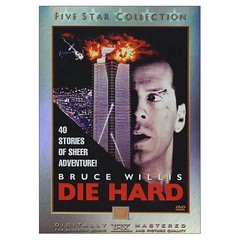
Die Hard
Die Hard (1988) - Directed by John McTiernan, starring Bruce Willis, Allan Rickman, Bonnie Bedelia, and Reginald VelJohnson.

Why You Should See It -- Because it's the most influential American action film of the last 20 years. It made Bruce Willis into a badass and started the "Die Hard on a ____" series of films. What makes Die Hard stand out from all of its imitators are the characters. The audience cares for John McClane because it's obvious that he just a regular joe who happens to be a cop (and a damn good cop to boot).

John McClane suffers throughout this film, either emotionally with the separation from his wife or physically by fighting the terrorists. C'mon, who doesn't cringe when McClane has to run across the broken glass in his bare feet? But, the other characters in the film are also great. McClane's wife is smart, strong, and a fully formed female character in a genre that isn't known for them. The villains are gloriously formed and funny as hell. And who can forget Ellis?

Another aspect of Die Hard I really enjoy is McClane's struggle to adjust to the West Coast, no limits 80's lifestyle. McClane feels lost in the excesses and wishes for simpler, quieter times. It's actually a theme that one finds in several action films, where the masculine characters have trouble dealing with changing cultural values and opinions of societies -- and, apparently, the new Die Hard film explores this idea as well.

Best Splosion
-- The rooftop explosion, where McClane has to bungee jump with a fire hose to escape from being burnt extra crispy.

One Liner
-- "Yippie Kie Yay, motherf@$%r!"

Film II

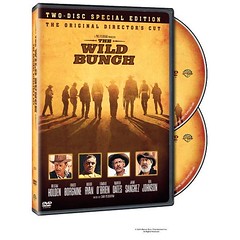
Wild bunch

The Wild Bunch (1969)-- Directed by Sam Peckinpah, starring William Holden, Ernest Borgnine, and Robert Ryan.

Why You Should See It -- Because it's one of the first Westerns to portray violence in realistic, gory detail. The violence in this film goes beyond the glorification normally found in most action movies and actually makes the viewers uneasy while viewing such destruction.
Plus, this is another film that deals with the theme of a group of men facing the changing times. Set during the Mexican Civil War, the group of bank robbers and desperadoes are a band of brothers who are falling apart because the Wild West ain't so Wild anymore. The brotherhood of outlaws is broken, because government officials are forcing a former member to hunt down the gang. And both groups soon find that the outlaw ways they stand for are nothing compared to the grand scale corruption and violence of the "law".

Best Splosion
-- The opening and closing gun fights are legendary and bloody.

One Liner
-- "If they move, kill 'em."

Film III

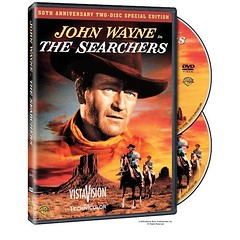
Searchers

The Searchers (1956) -- Directed by John Ford, Starring John Wayne, Jeffrey Hunter, Vera Miles, and Natalie Wood.

Why You Should See It -- For perhaps John Ford's best film (and that's saying something) and John Wayne's best acting. I've used the previous two films to talk about how the past and the future come together for the heroes. It happens here, in a slightly different way. John Wayne's character, Ethan, is a man who lives in and is haunted by the past, particularly past tragic run in with Comanche Indians. Ethan is a complex character -- a man in love with his brother's wife, a racist, and a man hellbent on revenge and on a rescue mission all at the same time. The themes of this movie make it one of the most complex Westerns, and the fact that Ford and Wayne embrace these complexities makes for an incredible film.

Best Splosion
-- This isn't a splosion film, although there are some fine action pieces. However, one of the most chilling scenes is when Ethan shoots out the eyes of a dead Comanche.

One Liner
-- "So we'll find 'em in the end, I promise you. We'll find 'em. Just as sure as the turnin' of the earth."

Film IV

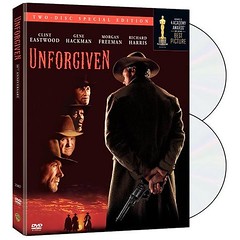
Unforgiven

Unforgiven (1992) -- Directed by and Starring Clint Eastwood, Morgan Freeman, Gene Hackman, and Richard Harris.

Why You Should See It -- Because Eastwood masterfully deconstructs the mythology and legend worship of the Wild West to show that hired killers and wild gunmen aren't heroes. And neither are the law men most of the time. Eastwood also continues the gritty, realistic violence found in The Wild Bunch and the character complexities and past haunted aura found in The Searchers.

Best Splosion
-- Again, not much on the splosion scale for this one, but there's plenty of violence that both entices and horrifies the audience at the same time. The best example is the final confrontation in the whore house.

One Liner
-- "All right, I'm coming out. Any man I see out there, I'm gonna shoot him. Any sumbitch takes a shot at me, I'm not only gonna kill him, but I'm gonna kill his wife, all his friends, and burn his damn house down. "

Film V

Outlaw

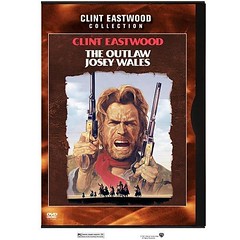
The Outlaw Josey Wales
(1976) -- Directed by and Starring Clint Eastwood, Chief Dan George, Sondra Locke, and John Vernon.

Why You Should See It -- One of the first films directed by Clint Eastwood, he begins using some of the same themes that would evolve into through the years and appear in Unforgiven. Eastwood plays Josey Wales, a Confederate soldier who lives to hunt down the Union soldiers who killed his family with no provocation.

However, the Civil War has ended, and all of Josey's gang turns themselves in. Josey won't do it though, and that's why he survives the slaughter of the gang. Persued by his former commander, along with the man who ordered Josey's family and gang killed, Josey makes a run for Mexico, picking up travellers along the way. Josey, like serveral of the other heroes I've mentioned here, is trapped in the past, but must learn to adapt to survive. This theme is used again in the Cherokee Indian Chief, Lone Watie (played by Chief Dan George), who has survived government oppresion and the Trail of Tears. Like Josey, Lone Watie must forge new alliances and try to move on from the past.

Best Splosion --
Josey mows down some conniving Union soldiers with a Gatlin Gun.

One Liner -- "
I didn't surrender, but they took my horse and made him surrender. They have him pulling a wagon up in Kansas I bet."

Film VI

Good, the Bad

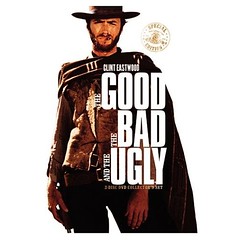
The Good, the Bad, and the Ugly ( Il Buono, il brutto, il cattivo) (1967) -- Directed by Sergio Leone, Starring Clint Eastwood, Eli Wallach, and Lee Van Cleef).

Why You Should See It -- Because it actually has splosions. That and Leone makes the most epic Western ever, giving nods to past Westerns while breaking all the conventional rules that had stifled the genre for so long in Hollywood. Many people think of Leone as the man who brought heavy violence to the Western, which is true to a point, but it must be remembered that Leone also almost fetishized the buildup to the violence gunfights found in his Westerns. Leone was all about exploring and deconstructing the rituals found in the violence of the Western genre, and, as he did so, Leone resurrected and profoundly changed these films.

Best Splosion -- Well, Eastwood and Wallach's characters, Bondie and Tuco, come upon a Civil War battle with lots of splosions. But, the height of action is the three way duel between Blondie, Tuco, and Angel Eyes.

One Liner -- "You see, in this world there's two kinds of people, my friend: Those with loaded guns and those who dig. You dig."


Labels: , ,

This site is a member of WebRing.
To browse visit Here.